
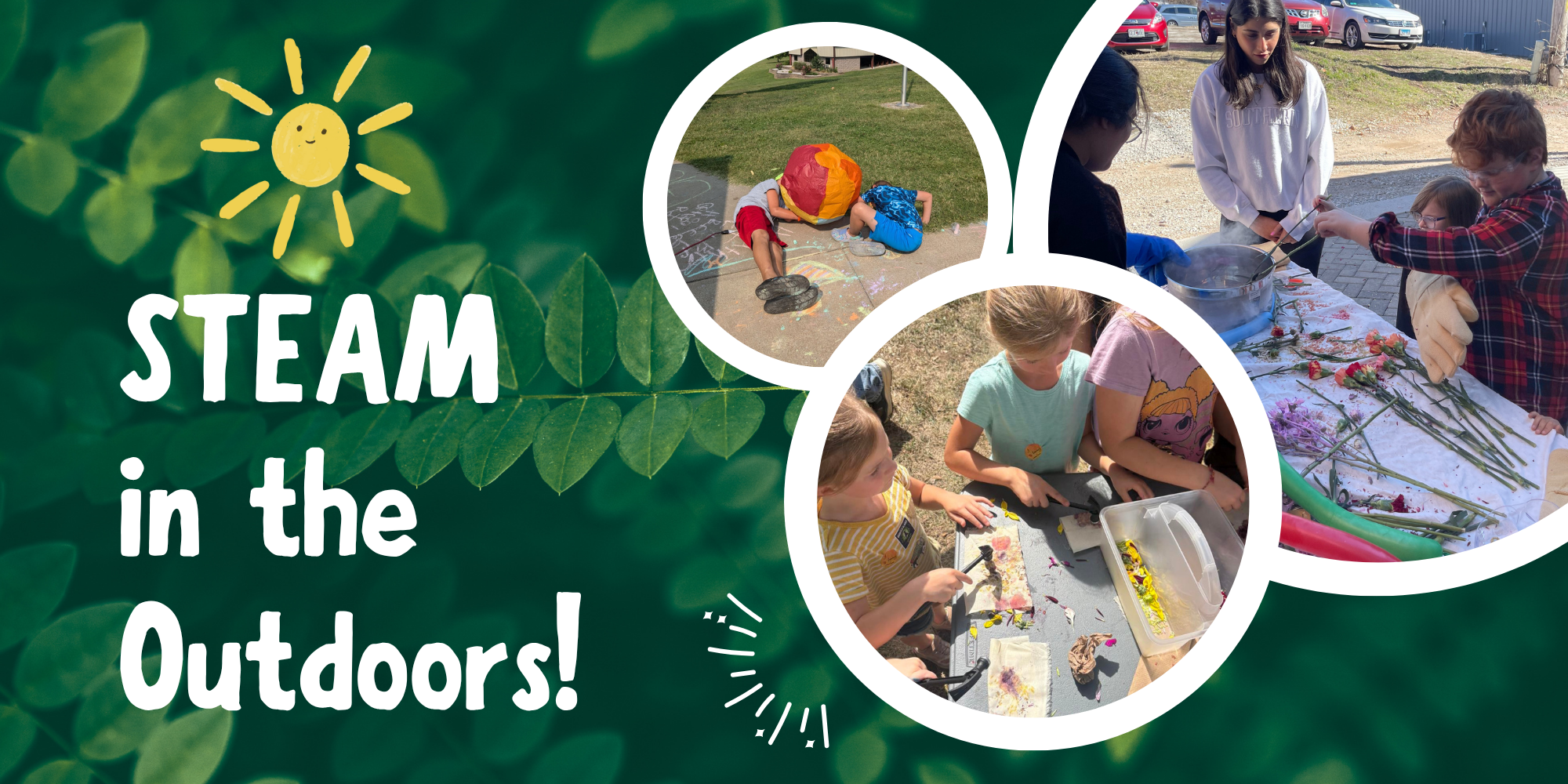
At the Exploreum, we believe that some of the best learning happens outside. Nature offers endless opportunities for children to explore science, technology, engineering, art, and math (STEAM) in ways that are fun, hands-on, and memorable. Whether it’s a walk through the park, a family hike, or a night of stargazing, the outdoors can transform into an interactive classroom.
Gardening is a wonderful way to bring science into everyday life. Families can test soil acidity with simple kits, observe how different conditions affect plant growth, and even chart the progress of seedlings over time. Kids learn about ecosystems, chemistry, and biology while enjoying the satisfaction of growing something themselves. By turning the backyard into a mini-laboratory, families can see firsthand how science supports life all around them.
Hiking is another place to explore STEAM. In addition to being great exercise—it’s an opportunity to integrate math and engineering. Children and teens can measure distances with step counts, estimate the height of trees, or experiment with building small rock cairns to study balance and stability. These challenges encourage kids to apply problem-solving skills in natural settings, making abstract math and engineering concepts both tangible and fun.
Stargazing is an amazing way to explore STEAM. Looking up at the night sky invites big questions and sparks curiosity about technology and exploration. Families can identify constellations, track the moon’s phases, or use apps to map planets and stars. This simple activity connects kids to astronomy and highlights how technology helps us understand the universe. Stargazing fosters wonder and shows children that science often begins with looking up and asking “what’s out there?”
The “art” in STEAM can be found everywhere outdoors. Leaves, flowers, and shells all display symmetry and patterns that inspire creativity. Children can sketch what they see, make leaf rubbings, or photograph natural designs to study geometry and artistic balance. These activities combine observation with imagination, teaching kids to see beauty and order in the world around them.
Think of nature like a living laboratory. Activities like testing soil, hiking with math challenges, stargazing, and studying natural symmetry not only build STEAM skills but also deepen our connection to the outdoors. By combining exploration with education, families can spark curiosity and create lasting memories—all while learning together under the open sky.