
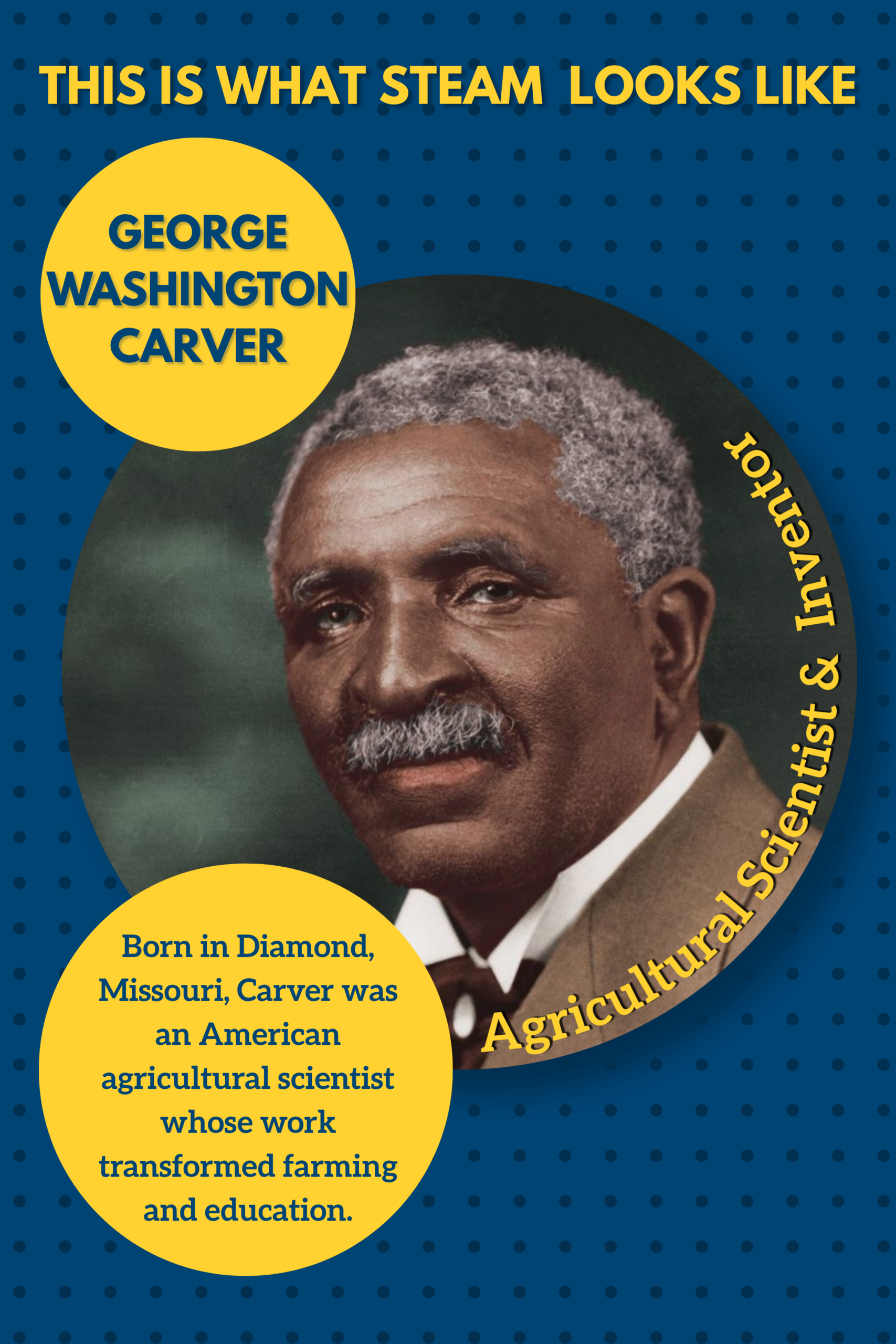
If you’ve explored the Schroeder Family Exploreum, you may have noticed some important faces throughout our exhibits. They are scientists, innovators, creators and problem-solvers whose curiosity helped change the world.
Now, we want to introduce you to them.
Welcome to People in STEAM, a new Exploreum series sharing the stories behind these remarkable people and showing the next generation that big ideas can start anywhere, even right here in Southwest Missouri.
And there may be no better person to begin with than George Washington Carver.
A Curious Kid from Southwest Missouri
Long before Carver became a renowned agricultural scientist, educator and humanitarian, he was a curious child exploring the natural world near Diamond, Missouri.
Born into slavery during the Civil War, Carver faced tremendous obstacles in his pursuit of an education. As a child, he developed a fascination with plants and became so skilled at caring for them that he became known as the “Plant Doctor.” [1]
That childhood curiosity grew into a lifelong love of learning.
Carver eventually attended Simpson College in Iowa, where he studied art and piano. His talent for painting plants helped lead him toward botany and agriculture. He later earned bachelor’s and master’s degrees in agriculture from Iowa State Agricultural College. In 1896, he joined the Tuskegee Institute in Alabama, where he spent 47 years teaching and researching. [2]
Carver and STEAM
Today, we use STEAM: Science, Technology, Engineering, Art and Math to encourage kids to ask questions, experiment, create and solve problems.
Carver was doing exactly that more than a century ago.
He studied plants, soil and agriculture and looked for practical solutions that could help farmers. He promoted crop rotation and alternative crops, including peanuts and sweet potatoes, to help improve soil depleted by repeatedly growing cotton. [2]
Carver was also an artist, demonstrating something we love about STEAM: science and creativity don’t have to live in separate worlds.
His work wasn’t simply about making discoveries. It was about finding ways to use those discoveries to help people.
One example was the Jesup Wagon, a movable school that brought agricultural demonstrations, tools and information directly to rural farmers who couldn’t travel to the Tuskegee campus. [3]
Carver believed knowledge was meant to be explored, applied and shared.
Why His Story Matters to Kids
At the Exploreum, we believe some of the best learning starts with questions:
Why does that happen? What if I try this? Could I make it work differently?
Those are STEAM questions, and they reflect the curiosity that shaped Carver’s life.
His story shows kids that scientists and innovators aren’t people who simply know all the answers. They’re people who observe, experiment, create, solve problems and keep asking questions.
Carver’s story also reminds us that learning can happen everywhere. His own journey began by observing plants and nature right here in Southwest Missouri.
That sounds a lot like exploring to us.
Explore His Story Right Here at Home
Today, families can visit George Washington Carver National Monument near Diamond, Missouri, and explore the landscape where Carver’s curiosity first took root. [1]
And this September, the Schroeder Family Exploreum will be there for Prairie Day!
Prairie Day 2026
Saturday, September 12, 2026
10 a.m. to 3 p.m.
George Washington Carver National Monument
5646 Carver Road, Diamond, Missouri
Free admission
Prairie Day invites families to explore life on the Missouri prairie during Carver’s childhood. Activities include basket weaving, Dutch-oven cooking, spinning, blacksmithing, live music, interactive exhibits and more. Kids can also earn a special Prairie Day Junior Ranger badge. [4]
Be sure to find the Schroeder Family Exploreum while you’re there and explore with us!
Curiosity Can Start Anywhere
George Washington Carver’s story began with a curious child exploring the natural world in Southwest Missouri. That curiosity grew into a lifetime of science, creativity, education and service.
The next great scientist, engineer, artist, inventor or problem-solver could be exploring at the Exploreum today.
Keep looking. Keep asking questions. Keep exploring.
Sources & Learn More
[1] National Park Service, George Washington Carver National Monument
https://www.nps.gov/gwca/index.htm
[2] National Park Service, “George Washington Carver”
https://www.nps.gov/people/george-washington-carver.htm
[3] National Park Service, George Washington Carver National Monument
https://www.nps.gov/articles/gwcarver.htm
[4] Missouri Division of Tourism, “Prairie Day Celebration at George Washington Carver National Monument”
https://www.visitmo.com/events/prairie-day-celebration-at-george-washington-carver-national-monument